Searching for a concealed carry permit NYC guide often leads to more questions than answers: Which agency handles your application? Do you need a handgun first? Does your course completion mean you can carry? Here are straightforward answers to help you understand the steps and prepare responsibly.
Quick answer: First, confirm the correct licensing authority for where you live or work. New York requires concealed-carry applicants to complete 16 hours of classroom instruction and two hours of live-fire training. The course is one part of the process, not a permit. Your licensing authority handles the application, fingerprints, interview, review, and final decision.
Requirements and procedures can change, and local authorities may have different instructions. Use the official sources linked below to check current details. This article is general information, not legal advice.
1. How do I get a concealed carry permit in New York, and where do I start?
Start by identifying the licensing authority that serves your residence or qualifying place of business, then follow that authority’s current application instructions. New York’s statewide training requirement is consistent, but application procedures vary by jurisdiction.
A practical starting sequence:
- Confirm your licensing authority. NYC applicants generally apply through the NYPD License Division. Nassau and Suffolk applicants use their county or local licensing authority. Do not assume the office that handled a friend’s application is the right one for your address.
- Read that authority’s current instructions. Check its application forms, fees, required documents, fingerprinting, interview, and submission process before assuming the steps are identical elsewhere.
- Plan for the required course. New York requires proof of training before a concealed-carry license is issued. Confirm with your authority whether it wants your completion certificate submitted with the application or afterward, because practice differs.
- Complete the remaining steps. Your licensing authority, not your training school, handles application review and the final decision.
The New York State concealed-carry FAQ and New York State Police firearms information are useful places to verify statewide guidance. NYC applicants should also check the NYPD’s official firearms licensing information.
2. How much does the 18-hour NYS concealed carry course cost?
C&G Solutions’ current course price is $350, and a $100 deposit is accepted. Range fees and ammunition are not included unless the specific class page says otherwise.
Before registering, review the details for your selected class, including what training equipment is provided, what you must bring, and any additional costs. The published cancellation policy requires seven days’ notice; review the current policy before booking rather than assuming a particular payment is refundable.
If you already hold a permit and need to keep it current, the 2-hour recertification course is $150.00 plus range fees, and HR218/LEOSA recertification is $100.00. Call or text us to schedule either one.
Bring a friend to the 18-hour course and both of you get $50 off your balance. Mention your friend’s name in the comment section when you register and we will apply the discount to both registrations.
For course details and upcoming sessions, visit the 18-hour concealed carry course page.
3. Where can I take an 18-hour concealed carry class near me?
C&G Solutions offers classes at our Oceanside classroom and our Whitestone classroom. Choose a location and date that work for you, then confirm the address and event details before registering.
Oceanside sits on the South Shore, an easy drive from Nassau and western Suffolk. Whitestone puts the class inside Queens, which is a shorter trip for anyone coming from Brooklyn, the Bronx, or Manhattan. Both classrooms run the same 16-plus-2 curriculum.

Check the course page for current class information. Confirm the exact location for your selected session; do not rely on an old listing or a prior class address.
4. Do I need to own a handgun or have a pistol permit before taking the class?
No. You do not need to own a handgun or already hold a pistol permit to take the course. Training equipment is provided unless the specific class page says otherwise, and no prior experience is needed.
Follow the registration and arrival instructions. Do not bring a personal firearm or ammunition unless the class instructions specifically tell you to do so. If you are unsure what to bring, ask before class rather than guessing.
5. What exactly happens during the 18-hour course?
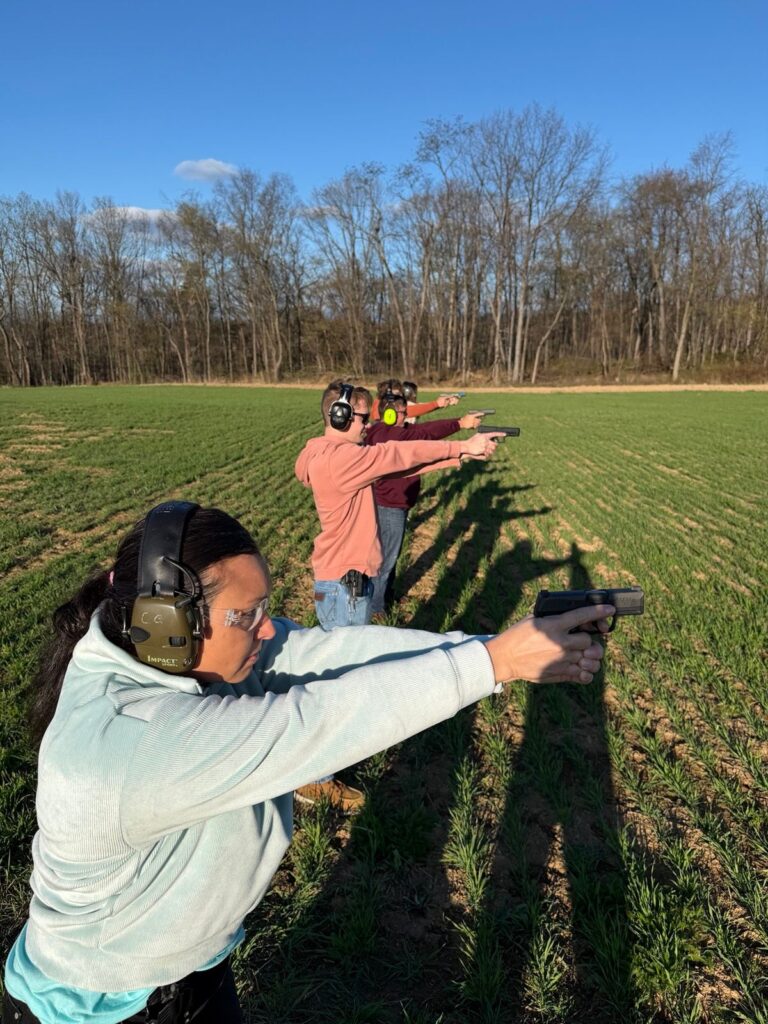
The course consists of 16 classroom hours and two hours of supervised live-fire training. It includes required assessments and covers knowledge and skills intended to support safe, responsible decisions.
Course topics include:
- Firearm safety and safe handling
- Safe storage
- New York and federal firearms laws
- Situational awareness and conflict de-escalation
- Interactions with law enforcement
- Sensitive locations and carry restrictions
- Legal responsibilities related to the use of deadly force
- Suicide prevention
- Marksmanship fundamentals and supervised live-fire training
The goal is not simply to complete a set number of hours. You should leave with a clearer understanding of the responsibility involved in carrying, along with practical instruction and a sense of where you may need more practice.
6. Do I need previous firearms experience?
No. Beginners are welcome. If you are nervous, tell the instructor. You should expect safety rules to be explained clearly, opportunities to ask questions, and instruction paced to help you understand what is expected before you take part in practical exercises.
You do not need to arrive knowing firearms terminology or how to operate a handgun. Come ready to listen, follow instructions, and take safety seriously. The course is a learning environment, not a test of whether you already know everything.

7. How difficult is the live-fire qualification, and what happens if I fail?
The stated C&G Solutions live-fire qualification is five rounds at four yards, with at least four rounds on target; the written test requires a score of 80%. These are course assessments, so take the instruction seriously and ask questions if a standard or direction is unclear.
If you do not meet an assessment requirement, do not treat that as a reason to rush or guess. Ask the instructor what the result means and what steps are available. Additional instruction may help you address specific skill gaps; C&G Solutions offers private pistol coaching. Coaching is additional training and does not guarantee a particular assessment result.
8. How long does it take to get a permit after completing the class?
There is no reliable single timeline to promise. Processing, fingerprinting, interviews, and application review are handled by the licensing authority, and the time involved depends on that authority and your application.
Completing the class does not issue a permit or authorize you to carry. Ask your licensing authority for current processing information and make sure you understand what must happen after you submit your course certificate. Avoid relying on someone else’s past timeline as a guarantee for your own application.
9. What is the difference between a NYC concealed carry license and a Nassau or Suffolk pistol permit?
A license issued outside NYC does not automatically authorize you to carry inside the five boroughs. Do not assume a Nassau or Suffolk permit lets you carry in NYC; verify your specific license and the applicable rules with the relevant licensing authority before traveling with a firearm.
The licensing authority, application process, and license conditions matter. Be especially careful when crossing jurisdictional boundaries. A misunderstanding can create serious legal trouble, even if your license is valid where it was issued.
10. How do I choose a reputable concealed carry training school?
Look beyond price. A responsible school should be able to explain its instructor qualifications, course structure, class size, assessment standards, student feedback, and what it teaches beyond the minimum hours.
Before enrolling, consider whether the school:
- Clearly explains the required schedule and what is included
- Gives beginners a safe, supportive way to learn
- Provides opportunities to ask questions and receive practical attention
- Explains the difference between course completion and a license
- Encourages continued skill development and responsible decision-making
C&G Solutions’ instructor team brings over 130 years of NYPD and EMS combined experience. Our emphasis is on instructor experience, practical education, personal attention, and convenient classrooms, not being the cheapest option. The right training should help you understand the responsibility, not just complete a requirement.
If you are a qualified retired law-enforcement professional, note that HR-218/LEOSA qualification is a separate pathway from civilian concealed-carry licensing. See the HR-218/LEOSA page for information. HR218/LEOSA recertification is $100.00; call or text us to schedule.
Choosing to pursue a permit is a serious decision. Start with your licensing authority, confirm current requirements, and approach the training as preparation for a responsibility, not merely a certificate.
Defend with skill, Act with confidence.
If you found this guide useful, share it with someone who is trying to understand the concealed-carry process.