

From the C&G training journal. Class dates and promotions mentioned in this article reflect its original publication. Check current class dates and course requirements before registering.
If you are working out how to become a security guard in NY, the honest answer is that it is a sequence, not a single application. You meet the basic eligibility rules, you finish the 8-hour pre-assignment course, you apply for state registration, you get fingerprinted, and then you keep training after you are hired. Each step has its own gate, and none of them substitutes for the others. A course certificate is not a registration. A registration is not the same thing as being ready for a post.
This beginner’s guide walks through how to become a security guard in New York in the order the state actually expects, what each required course covers, what the training costs, and what the work is really like once you are on a schedule. Confirm current forms and fees with New York State before you apply, because the paperwork is yours to file, not the school’s.
What does a security guard do?
Security guards help protect people, property, and operations. Depending on the assignment, you might monitor an entrance, check credentials, patrol a property, observe cameras, write incident reports, or contact emergency services when needed. Guards work in many settings, including:
- Office buildings and residential properties
- Retail stores and shopping centers
- Hospitals and healthcare facilities
- Schools, campuses, and event venues
- Construction sites and commercial properties
The daily work depends on the employer, the location, and the assigned duties. A guard at a residential building may focus on access control and visitor assistance. A guard at a construction site may monitor entry points and report safety or security concerns.
Professionalism is central to the job. You are expected to follow employer procedures, communicate clearly, remain attentive, and understand the limits of your role. Security guards are not police officers. Your responsibilities and authority are defined by law, your employer, and the assignment, and staying inside those lines is what keeps you and everyone around you safe.
Who oversees security guard registration and training?
Two New York State agencies have important roles:
- The New York State Department of State (DOS) handles security guard registration.
- The New York State Division of Criminal Justice Services (DCJS) sets the security guard training standards that approved schools must meet.
In practical terms, a training school provides the required instruction and the course completion documentation. The Department of State handles the individual registration application. You need to complete both halves. Taking a class by itself does not authorize you to work as a registered security guard, and no school can file the application for you.
For current requirements, check the state’s security guard training requirements and application guidance, and the DCJS required training resources page for the standards schools are held to.
The typical steps to become a security guard in New York
1. Check the basic eligibility requirements
Applicants generally need to be at least 18 and meet New York’s character and criminal-history requirements. Certain convictions or other circumstances may affect eligibility, but do not assume that any past record automatically disqualifies you. Review the state’s current guidance and contact the Department of State if you have questions about your individual situation.
Security guard registration and permission to work in the United States are separate matters. If hired, you must meet applicable federal employment-authorization requirements. The employer can explain what documentation is needed for its hiring process.
2. Complete the 8-hour pre-assignment course
Before applying for registration, you generally need to complete the 8-hour pre-assignment training course at a DCJS-approved school. The course introduces the core information needed for an entry-level security role, and you receive documentation of course completion to include with your application.
A useful course does more than move quickly through material. It should help you understand the responsibilities and limits of the job, communicate professionally, recognize potential problems, and follow instructions in a structured way. Ask the school how course completion is documented and what you need to bring on the day. 
3. Apply for registration with the Department of State
After completing the required pre-assignment course, submit the security guard registration application to the New York State Department of State, following the current instructions. The application process includes identity and background-check requirements.
Fingerprinting is part of the process. Follow the Department of State’s current directions for scheduling and completing electronic fingerprinting, and keep the receipt and any other documentation required for your application. You may also need supporting information depending on your circumstances.
Be accurate and complete on the forms. If you are uncertain about a question or a past record, seek guidance from the Department of State rather than guessing. The state determines whether an application meets its requirements, and a small avoidable error is the most common reason a first application slows down.
4. Complete 16-hour on-the-job training after employment
After you are hired, you generally must complete 16-hour on-the-job training within 90 days of your initial employment. This training is designed to connect your foundational knowledge to the responsibilities of an actual post.
Your duties can vary considerably by site. Ask your employer how the training will be arranged and what site-specific procedures you are expected to learn. Understand who to contact with questions, how incidents should be reported, and what responsibilities apply to your particular post. The 90-day clock is real, so put it on a calendar the week you start.
5. Keep up with annual in-service training
Security guard training continues after the first course. Registered guards generally must complete 8-hour annual in-service training in each calendar year in which they hold registration. Training is also relevant to keeping a registration current and meeting renewal requirements.
Keep your certificates and training records organized. Do not wait until a renewal deadline is near to check whether you have completed what is required. Confirm the current schedule and renewal instructions with the Department of State and DCJS.
What does the training cost?
New York sets the curriculum, but schools set their own fees, so prices vary across the state. Our current pricing is straightforward and posted on each course page:
- 8-hour pre-assignment course: $60.00
- 16-hour on-the-job training: $215.00
- 8-hour unarmed annual in-service refresher: $60.00
- 8-hour armed annual in-service refresher: $100.00
- 47-hour armed guard course: $800.00
Register with a friend and both parties get $50 off their balance. Just mention your friend’s name in the comment section when you register so we can match the two registrations. If you are still deciding between unarmed work and armed work, start with the pre-assignment course and let that decision come later. The 47-hour armed course rests on requirements that take time to satisfy, and it is not an optional add-on to the basic course.
What is the difference between unarmed and armed registration?
An unarmed security guard performs assigned duties without carrying a firearm as part of the job. Many roles focus on observation, communication, access control, customer service, and written reporting.
An armed security guard has additional legal and training requirements. These generally include a valid New York State pistol license and additional security and firearms training, including the state-required 47-hour firearms training course. Armed registration comes with continuing requirements as well. Carrying a firearm does not give a guard police powers, and the legal boundaries you learned in the first course become more consequential, not less.
If your career goals include armed work, review the latest state rules and employer requirements before choosing a training path. C&G Solutions’ firearms courses and private pistol coaching are separate firearms-training options; they do not replace any security-guard-specific requirement. 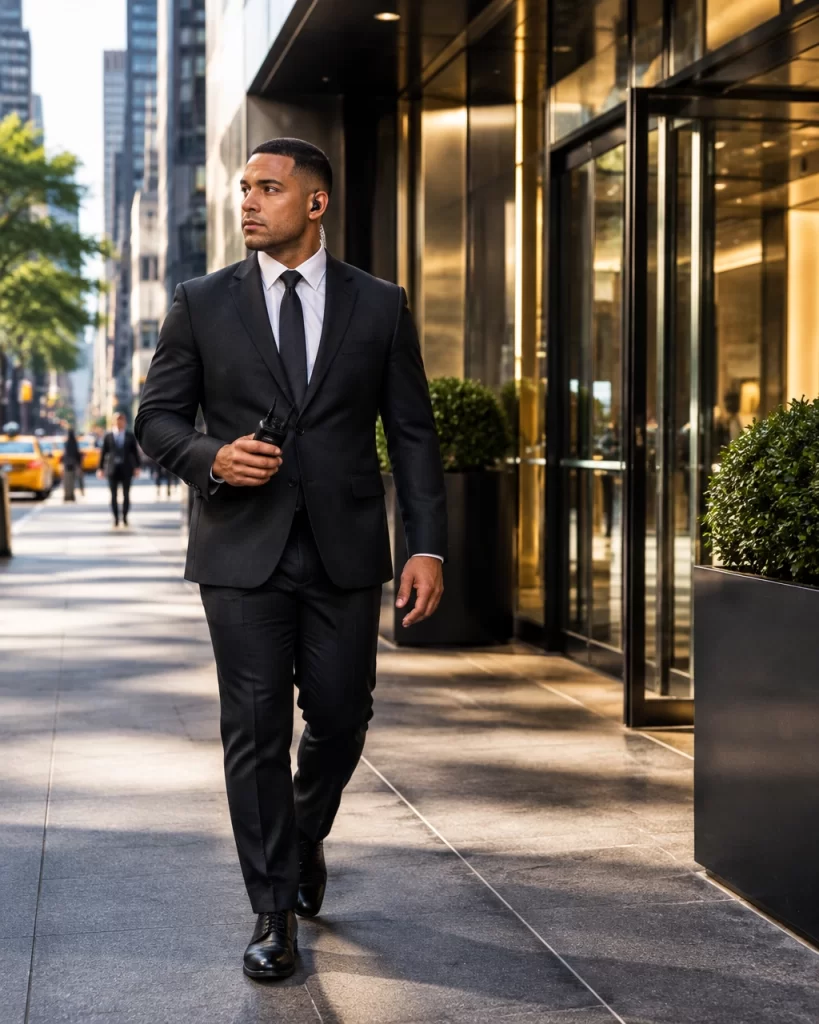
What should you expect from a quality training school?
A solid training experience should make the requirements understandable, particularly if you are new to the industry. Look for instruction that:
- Explains the guard’s role, responsibilities, and professional boundaries
- Helps you understand communication, observation, and incident reporting
- Gives you clear information about attendance and course-completion records
- Welcomes questions and explains unfamiliar terms
- Distinguishes required state training from additional career development
Training gives you a foundation; the employer and worksite provide the specific procedures for your assignment. Take both seriously. A clear report, calm communication, and sound judgment can matter as much at a 3 a.m. post as anything you memorized for the exam.
Where you train and who teaches the class
Our security guard courses run in our Oceanside classroom on Long Island and our Whitestone classroom in Queens, and current class dates and seating are listed on the training calendar. If a session is not yet posted, call or text us and we will tell you where the schedule stands rather than leaving you to guess.
C&G Solutions is an approved NYS DCJS Security Guard Training School, school identification number 302485. Instruction is led by Chris Goemans, who brings 30+ years across EMS, teaching, and security, and the team carries over 130 years of NYPD and EMS combined experience. That background matters in the parts of the job that do not show up on a written exam: a calm voice at a contested entrance, a report that reads clearly six months later, a decision made correctly when a situation is still developing.
What is security work really like?
Security work is not one uniform job. Some positions involve long periods of observation, while others require frequent interaction with residents, employees, customers, or visitors. Schedules, physical demands, and responsibilities vary by employer and site. Expect to be evaluated on reliability, communication, punctuality, judgment, and how well you follow instructions.
Your employer may provide post orders, the written directions describing the duties and procedures for your assignment. Read them carefully, ask questions, and do not improvise beyond your training or your authority. For career changers, veterans, and retired professionals, prior experience is useful, but each site has its own expectations. Learn the employer’s procedures rather than assuming one workplace operates like another.
Your next steps
The path is straightforward, but every part has a purpose: complete the 8-hour pre-assignment course, apply for registration with the Department of State, meet the fingerprinting and background requirements, complete the 16-hour on-the-job course within the required window after employment, and stay current with annual in-service training.
To check for course updates, visit New York security guard training on the C&G Solutions website, review upcoming classes in Oceanside and Whitestone, or ask our team about your next training step. Follow C&G Solutions on Instagram and Facebook for new dates as they are confirmed.
Defend with skill, Act with confidence. If this guide helped you understand how to become a security guard in NY, share it with someone weighing the same decision.